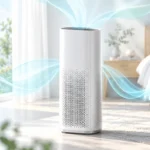
Air purifier boxes are full of numbers, but only a few tell you whether a machine will help in your room. We researched the common specifications and features so you can compare models without paying for claims that sound better than they are.
What a HEPA Filter Actually Does
HEPA describes a filter’s ability to capture particles under a defined test. A true HEPA filter is commonly rated to capture at least 99.97% of particles measuring 0.3 microns in a single pass. That does not mean smaller particles simply pass through: filters can capture particles both smaller and larger than the test size through different mechanisms.
Look closely at the wording. “HEPA-type” and “HEPA-like” do not, by themselves, promise the same performance as a true HEPA rating. Also check whether the claim applies to the filter alone or to the complete purifier. Air that leaks around a poorly fitted filter will not be cleaned as intended.
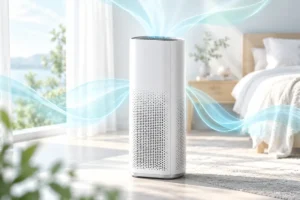
HEPA filters help with airborne dust, pollen, smoke particles and pet dander. They do not remove settled dust from furniture, and a particle filter alone is not a solution for odors or gases. A strong filter matters, but so does the amount of air the purifier can move through it.
CADR Tells You How Much Clean Air You Get
Clean Air Delivery Rate, or CADR, measures how quickly a purifier delivers air cleaned of particular particles. It is usually listed in cubic feet per minute, or cfm, in the United States. A higher number generally means faster particle removal in the same room.
You may see separate CADR figures for smoke, dust and pollen. The smoke figure is useful when comparing performance against finer particles; pollen figures are often higher. Compare the same pollutant and unit across models rather than picking whichever number looks biggest.
CADR also needs context. Check which fan speed produced the rating, because the highest setting may be too loud for everyday use. If a listing gives only a filter efficiency percentage and no airflow or CADR information, it is hard to judge how quickly the machine will clean a room.
A larger CADR is not automatically better value. The useful goal is enough clean airflow for your space at a speed you can comfortably leave running. An oversized machine operated gently may suit a bedroom better than a smaller one that must run at full speed.
Match the Room Rating to Your Real Space
A room-size claim is only meaningful if you know how it was calculated. Some labels assume several air changes per hour, while others advertise a much larger area cleaned only once an hour. If the listing states the air changes per hour, compare that figure alongside the square footage. For particle control, several changes per hour are more useful than one.
Ceiling height matters, too. A room with a high ceiling contains more air than the same floor area with a standard ceiling. Open doors, connected spaces and drafts can also make a purifier work harder. When your room falls near the top of a model’s rating, consider more capacity rather than relying on its maximum-speed claim.
Place the purifier where air can enter and leave freely, not tight against curtains or hidden behind a sofa. In a small home office setup, leave space around the unit and keep its airflow from blowing papers across your desk. One portable purifier generally works best in the room where you spend time, not across an entire closed-off home.
Read Noise Ratings Before Choosing a Fan Speed
Noise is often the specification that decides whether a purifier gets used. Ratings are usually given in decibels, or dB, but a single low number may describe only the quietest setting. Check for noise figures across several speeds, especially the setting you expect to use for hours at a time.
Higher airflow usually brings more fan noise. Sleep mode may be pleasantly quiet, yet move much less air than the speed used for a room-size or CADR claim. If the manufacturer does not make that difference clear, treat a large room rating and an extremely quiet claim as separate facts, not a promise you will get both at once.
Sound character matters as well as volume. A steady low hum may be easier to ignore than a whine or frequent speed changes. Auto mode can cause those changes when its sensor reacts to cooking, dust or other activity. For a shared workspace, the same comfort questions come up when choosing earbuds or headphones for long sessions: a specification cannot fully tell you what you will tolerate for hours. Look for detailed noise information and a usable manual speed control.
Separate Odor Claims From Particle Filtration
Odors and gases are different from the particles a HEPA filter captures. Activated carbon can help absorb some odors and certain gases, but the amount of carbon matters. A thin carbon-coated sheet may offer limited odor control compared with a substantial carbon filter. Be cautious when a product promises to remove every smell without explaining its filter materials.
Ventilation and fixing the source still come first. A purifier cannot repair a moisture problem, stop smoke from entering a room or replace a kitchen exhaust fan. For persistent or strong odors, investigate the cause rather than expecting a portable machine to hide it.
Check the replacement schedule and filter availability before choosing a model. Prefilters may need regular cleaning, while HEPA and carbon filters eventually need replacement. The schedule depends on use and air conditions, so treat it as a guide and follow the maker’s instructions. Avoid washing a filter unless its instructions explicitly say it is washable.
Be wary of ozone-generating features marketed as a shortcut to cleaner air. Ozone can irritate the lungs. If a model includes an ionizer, check whether you can turn it off and whether the purifier performs well without it.
Decide Which Extras Earn Their Place
An air-quality sensor can make auto mode convenient, but a built-in reading is not a complete picture of your home’s air. Sensors vary in what they detect and how accurately they respond. A display that changes color is useful feedback, not proof that every pollutant has been measured or removed.
App controls, schedules and voice commands can be worthwhile if they help you run the purifier consistently. They are less important than adequate airflow, tolerable noise and affordable replacement filters. Before paying more for connected features, check whether basic controls still work without an account or an internet connection.
Wi-Fi compatibility deserves a quick look if you want app control. Some connected appliances use only 2.4 GHz Wi-Fi, so check your network settings rather than assuming a connection will be effortless. Our guide to Wi-Fi 6 and Wi-Fi 7 explains why a newer router standard is not automatically necessary for everyday connected devices.
Timers, a dimmable display, a child lock and clear filter reminders are simple extras that may make daily use easier. Pay for the ones you will use, not the longest feature list.
A Practical Checklist for Comparing Two Models
Start with the room where the purifier will spend most of its time. Then compare two candidates in the same order, using the manufacturer’s specifications and filter information rather than the biggest number on the box.
- Particle performance: Look for a clearly described HEPA filter and a smoke CADR, ideally from a recognized independent rating program.
- Room fit: Check the stated air changes per hour and allow extra capacity for high ceilings or connected spaces.
- Daily comfort: Compare noise at useful fan speeds, not just in sleep mode.
- Ongoing care: Confirm that replacement filters are available and note how often the instructions say to change them.
- Extras: Choose carbon for a realistic odor need and connected controls only if they improve how you use the machine.
Finally, consider electricity use if the purifier will run continuously. For example, a 40-watt unit running all day uses about 0.96 kilowatt-hours per day; actual use depends on fan speed. If you are building a wider connected home, our smart home starter guide can help you decide whether app control belongs on your priority list. For most buyers, reliable cleaning at a comfortable noise level matters more.
Frequently Asked Questions
Is a true HEPA filter enough to choose a purifier?
No. Check CADR, room fit, noise and replacement filter availability as well; a good filter is less useful if too little air passes through it.
Can one portable purifier clean my whole home?
Usually not if rooms are separated by doors or walls. Use it in the room where you spend time, or consider separate units for separate spaces.
Should I run an air purifier all day?
Many models are designed for continuous use, and steady operation can help maintain cleaner air. Follow the manufacturer’s instructions and choose a fan speed you can live with.
Will an air purifier remove cooking smells?
A substantial activated carbon filter may reduce some odors, but ventilation and removing the source remain important. A HEPA particle filter alone is not designed to capture gases.
Final Thoughts
Choose an air purifier by matching its clean airflow to your room, then checking whether you can live with its noise and filter upkeep. HEPA claims, room ratings and smart features are easier to judge when you read what each one actually measures. The best choice is a machine you can run regularly, not one with the most impressive-looking box.