Budget phones have improved a lot, but the spec sheets are still full of confusing numbers and marketing words. This guide gives you a simple checklist for the five things that matter most: processor, RAM, battery, camera and software updates. We researched how these parts affect everyday use, so you can pick a phone that still feels good two or three years from now.
What Counts as a Budget Phone in 2026?
There is no official definition, and prices change from country to country. In general, a budget phone sits below the mid-range models and well below the flagships that brands advertise the most.
As a rough guide, many buyers think of budget phones as costing somewhere around $100 to $300 as of late 2026. Local taxes, currency and sales can move that range up or down, so treat it as a loose starting point, not a rule.
What matters more than the exact price is the balance. A good budget phone does the basics well: it runs common apps smoothly, lasts a full day on a charge and keeps getting security updates. It will not have every premium feature, and that is fine.
The key is knowing which corners a brand has cut. Some cut the camera to give you a bigger battery. Others add a fancy camera but use a slow chip. The sections below help you spot those trade-offs.
Processor: The Engine of Your Phone
The processor, often called the chipset, is the brain of the phone. In phones it is usually a system on a chip, which means the main processor, graphics and other parts are packed into one small piece.
You do not need to memorize model names. Instead, focus on a few simple points:
- Newer is usually better. A chip released in the last year or two tends to be faster and more power efficient than an older one.
- Ignore core counts alone. “Eight cores” sounds impressive, but almost every phone has that now. It does not tell you much.
- Check independent reviews. Look for comments on whether the phone feels smooth when switching apps and scrolling.
For most people, the processor only needs to handle messaging, social media, video streaming, maps and light games. Almost any recent budget chip can do that. If you play demanding 3D games, however, the processor becomes one of the most important choices you make.
RAM and Storage: Room to Work and Room to Keep
RAM and storage are easy to mix up. Think of RAM as your desk and storage as your filing cabinet.
RAM is the short-term memory your phone uses while apps are open. More RAM lets you jump between apps without them reloading. In 2026, 6GB is a sensible minimum for most people, and 8GB gives more breathing room for the years ahead. Phones with 4GB can still work, but they often feel slow sooner.
Some phones advertise “virtual RAM” or “extended RAM,” which borrows space from storage. It can help a little, but it is slower than real RAM, so do not count it as the same thing.
Storage is where your photos, videos and apps live. Apps and system updates keep getting bigger, so 128GB is a good minimum today. If you shoot lots of video, look for more storage or a phone with a memory card slot.
Remember that the system software already takes up part of the storage before you install anything.
Battery and Charging: Getting Through the Day
Battery life is one area where budget phones often do very well. Because they use simpler screens and efficient chips, many of them last longer than expensive models.
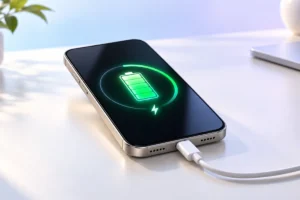
Battery size is measured in mAh (milliamp hours). A bigger number usually means a longer-lasting battery, and around 5,000mAh is common in budget phones today. But size is not the whole story. An efficient chip and well-tuned software can make a smaller battery last longer than a larger one.
When you compare phones, look at these points:
- Real-world battery results from independent reviews, not just the mAh number.
- Charging speed, shown in watts (W). Higher numbers mean faster charging.
- Whether a charger is included in the box. Many brands no longer include one, which adds a hidden cost.
Very fast charging is nice, but a phone that lasts all day matters more for most people.
Camera: Look Past the Megapixels
Camera specs are where marketing gets the loudest. A box may say “50MP” or even “108MP,” but megapixels alone do not decide photo quality.
What really matters is the size of the camera sensor, the quality of the lens and how well the phone processes the image. A good 50MP main camera can easily beat a poorly tuned 108MP one.
Also be careful with phones that list three or four cameras. On budget models, the extra ones are often low-resolution “macro” or “depth” cameras that add little value. One solid main camera is worth more than several weak ones.
Here is a simple way to judge a budget camera:
- Look at sample photos in independent reviews, especially indoor and night shots.
- Check whether the main camera has image stabilization, which helps reduce blur.
- Pay attention to how quickly the camera app opens and takes a photo.
Expect good photos in daylight. Low-light shots are usually where budget phones fall behind.
Software Updates: The Feature Most People Forget
Software updates are easy to overlook, but they decide how long your phone stays safe and useful. There are two kinds to know about.
Operating system updates bring new features and bigger changes, such as a new version of Android. Security updates fix problems that could put your data at risk. Security updates are the more important of the two.
Several brands now promise multiple years of updates, even on cheaper models. Others offer very little. Before you choose, check the brand’s official update policy for that exact model, and note the number of years it covers.
Keep in mind that the clock usually starts when the phone launches, not when you buy it. A phone released two years ago may have less support left than a newer model.
Also look at the software itself. Some budget phones come with lots of pre-installed apps and ads. A cleaner interface feels faster and is easier to use.
Your Simple Budget Phone Checklist
Use this quick checklist when you compare two or three phones side by side. If a phone misses more than one or two points, think twice.
- Processor: Released in the last year or two, with reviews describing smooth everyday use.
- RAM: At least 6GB of real RAM, ideally 8GB.
- Storage: At least 128GB, or a memory card slot.
- Battery: Around 5,000mAh, with good real-world results in reviews.
- Charging: Reasonable speed, and you know whether a charger is included.
- Camera: One strong main camera rather than many weak ones.
- Updates: A clear, written promise of several years of security updates.
- Software: Few ads and few unwanted pre-installed apps.
A few extra tips: check whether the phone supports the mobile networks in your area, and read the return policy before you pay. Older flagship phones can also be an option, but check how much update support they have left.
Frequently Asked Questions
Is 4GB of RAM enough in 2026?
It can work for very light use, such as calls, messages and a few apps. But apps keep getting heavier, so 6GB or more is a safer choice if you want the phone to last.
Do I need 5G on a budget phone?
Many budget phones now include 5G. It is useful if 5G coverage is good where you live and you plan to keep the phone for several years. If coverage is weak in your area, it matters less.
Are more cameras always better?
No. On budget phones, extra cameras are often low quality. A single good main camera, plus perhaps a decent ultra-wide, is usually more useful than four average ones.
How many years of updates should I look for?
Aim for a phone with several years of security updates promised by the brand. The longer the support, the longer your phone stays safe to use for banking, shopping and personal data.
Final Thoughts
Choosing a budget phone does not have to be confusing. Focus on a recent processor, enough RAM and storage, a battery that lasts all day, one good main camera and a clear update promise. Ignore the biggest numbers on the box and read independent reviews instead. With this checklist, you can find a phone that fits your budget and serves you well for years.